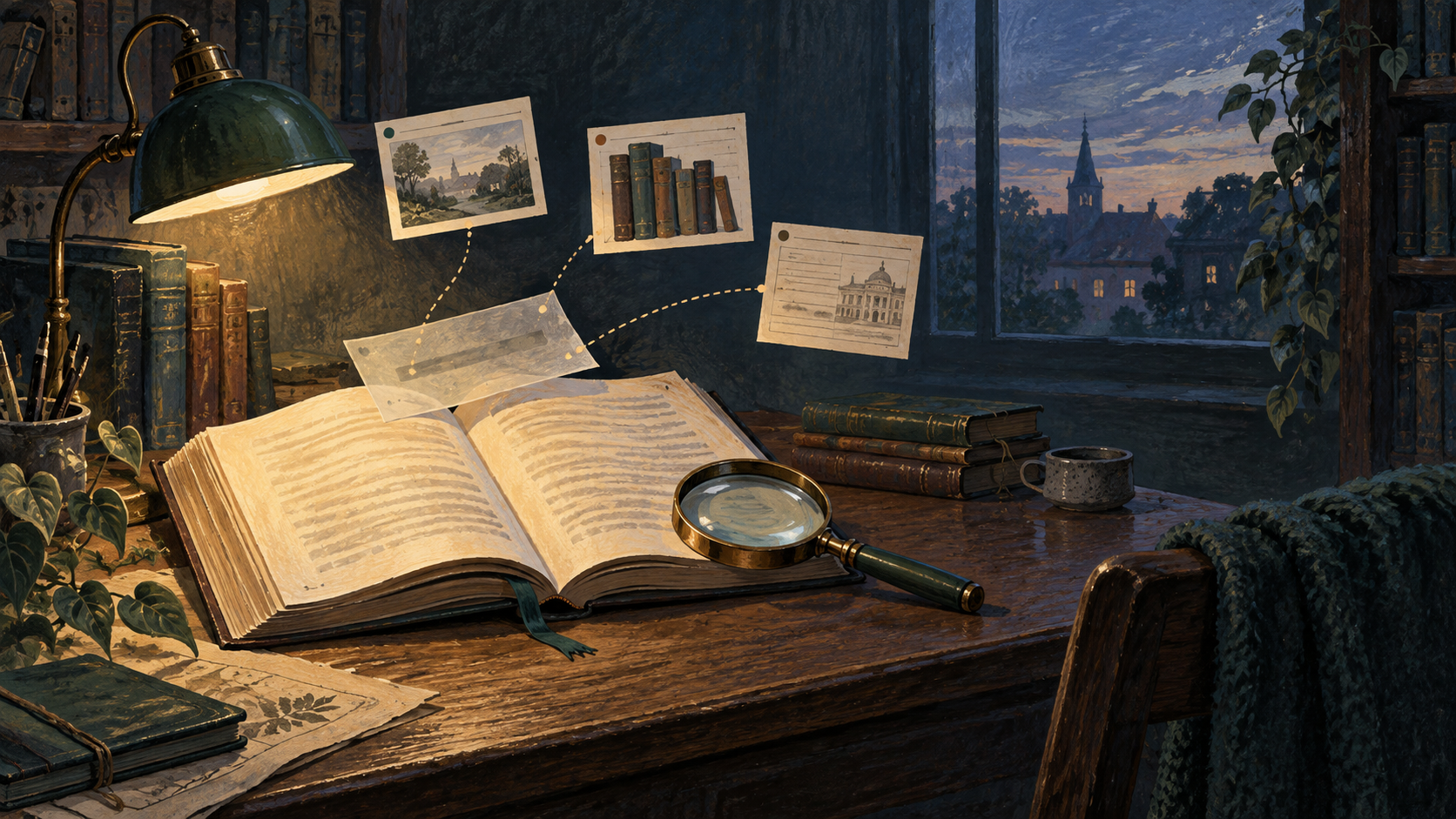
A remembered line can feel exact because its rhythm survived. That does not guarantee the words, speaker, medium, or book survived with it. A quotation may be paraphrased, translated, lifted from a review, or remembered from an adaptation. The task is not to make the line more searchable; it is to test its context.
Preserve the first version
Write the line down before changing punctuation, spelling, or grammar. Add where you think it appeared: narration, dialogue, an epigraph, a school handout, a film, or a review. Record the language and the approximate time you encountered it.
Then mark words as certain, near-certain, or replaceable. Searchable phrases are helpful only when they remain connected to this uncertainty. Rewriting a fuzzy line into polished prose can erase the very feature that would reveal it as a paraphrase.
Search from the stable center outward
Begin with the most distinctive consecutive words you trust. If that produces nothing useful, remove one uncertain word at a time rather than adding guesses. A match is only a candidate until it explains the surrounding scene, speaker, and edition.
Use catalog records to verify title and contributor information. For text snippets or digital previews, respect the provider’s access limits and avoid reproducing long passages. The point is to identify and verify, not to copy a text.
Test the candidate against context
For each candidate, answer these questions:
- Who says or writes the line?
- What happens immediately before and after it?
- Does the remembered setting, character, or tone agree?
- Is the wording different because of a translation, revised edition, audiobook, or screen adaptation?
Two matches on the line alone are weaker than one match that also fits the scene. Use a small note like the one in Turn a Reading Memory Into Useful Clues to keep evidence and interpretation apart.
Treat translations and adaptations as related sources
Different translations can legitimately use different wording. Audiobooks may abridge text; subtitles and screenplays can transform it further. When a line points toward a work but does not appear in one edition, do not immediately reject the lead. Identify the language, format, and approximate release first. The edition-comparison method in Read the Edition Clues Behind a Book Cover can help organize that check.
Know when the line is not enough
If every result has a different setting or speaker, return to the memory note and use nonverbal clues. A quote may be a doorway, but it should not overpower stronger evidence about the reading context. Good verification ends with a source you can revisit and an honest record of any remaining doubt.
Build a quote-evidence card
For each line, create five fields: remembered wording, stable words, suspected medium, date or reading context, and the result of each search. Keep another line for what a source actually proves. A catalog record establishes an edition; it does not prove that a sentence appears in it. A preview can show words in context, but may not represent every edition. This distinction prevents a review that quotes a book from being mistaken for the book itself.
Search variants without erasing the original
Keep the strongest two-to-five-word sequence unchanged, then test one alternate spelling, tense, or synonym at a time. If the memory may be translated, label the remembered and likely original languages rather than mixing them in one query. Note failed searches: an unsuccessful exact phrase may indicate paraphrase, translation, or adaptation, not a useless memory.
Confirm speaker, scene, and edition
When a possible match appears, identify the speaker or narrator, their relationship to others, and what happens immediately before and after the line. Words without the remembered scene are a coincidence until another source supports them. Page numbers shift, translators choose different phrasing, and abridgments remove text; name the edition or format consulted rather than claiming universal wording.
Respect access and know when to stop
Use legitimate catalogs, licensed previews, libraries, and publisher information. Quote only the short fragment needed for identification, never substantial text. Pause when a candidate explains words, speaker, scene, and reading context—or when an edition difference clearly explains the mismatch. Otherwise return to nonverbal clues. A quotation should strengthen a case, not carry one alone.
Distinguish quotation, paraphrase, and association
Before searching, classify the memory. A quotation is a sequence you believe you heard or read verbatim. A paraphrase preserves an idea but not the original wording. An association may be connected with a review, classroom discussion, or adaptation rather than text from the work. These categories need different evidence. Exact wording can be tested against previews; an association needs scene, contributor, or reading-context clues.
Do not treat a paraphrase as a failed search. Extract the nouns, relationship, and unusual image that survived, then search those as concepts and check whether a candidate contains a passage with the same function in the story. Record that the wording was reconstructed, so nobody mistakes it for a verified quotation.
Check editions in a controlled order
Choose one accessible edition and record its language, publisher, date, and format. Check the passage there first. If it is absent, compare a second edition that differs in translation or publication history. Only after that investigate an audiobook, subtitle, screenplay, or review. Changing several variables at once makes a negative result impossible to interpret.
Use legal access and keep excerpts short. Link to the catalog or publisher page and describe the verification level: exact text, close wording, secondary quotation, or thematic match.
Report confidence without false precision
Use labels such as “confirmed in this edition,” “probable work, wording varies,” or “unresolved lead.” Confidence rises when independent evidence converges on line, speaker, scene, reading context, and edition. It falls when a result matches only a common phrase or appears only in an unsourced quotation database. End with the best candidate, the exact source checked, the reason it fits, and one remaining uncertainty.
Sources
- Library of Congress search help — exact-phrase and keyword-search guidance.
- Google Books API: Using the API — documented full-text and fielded volume search.
- Library of Congress Catalog — catalog records for checking title, author, and edition details.
- Open Library API guidelines — responsible use of structured book data.